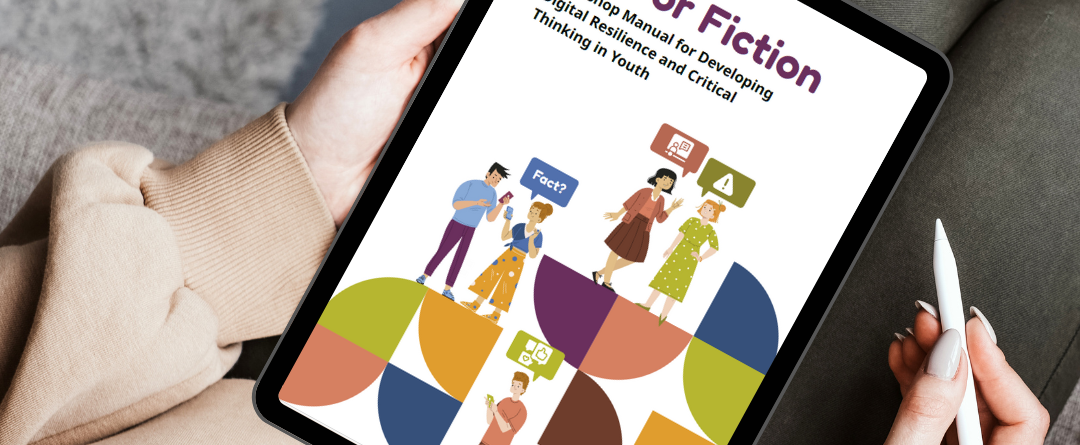
Workshop Manual for Developing Digital Resilience and Critical Thinking in Youth
Over the past six months, Mano Europa team and partners from Poland and Latvia, have worked intensively on the development of this Manual as part of the Fact or Fiction: Developing Inquiry and Critical Thinking Skills in Youth initiative.
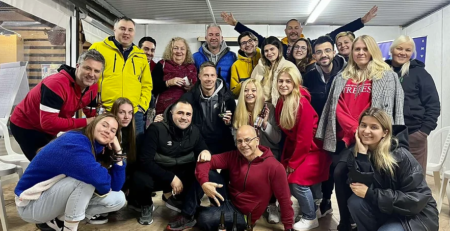
This collaborative process included consultation sessions with nearly a hundred young people (aged 12–19), feedback from educators and youth workers and pilot testing in schools and youth centers – all to ensure the Manual truly reflects the realities, hopes, and challenges of European youth and their educators.
Workshop Manual for Developing Digital Resilience and Critical Thinking in Youth
A practical, engaging resource for educators working with young people aged 12–19
In a world shaped by rapid digital change, information overload and new social challenges, young people need more than just knowledge – they need the ability to think critically, navigate uncertainty and build resilience.
The Workshop Manual for Developing Digital Resilience and Critical Thinking in Youth is designed precisely for that mission. Created for teachers, youth workers and facilitators, it offers a rich collection of practical tools to help cultivate thoughtful, curious and empowered young citizens across Europe.
You can find here a Manual in Lithuanian language and in English language.
What’s Inside the Manual?
✔ Six full-length scenarios (45-90 minutes)
Each scenario unfolds through clear phases — warm-up, main activity and reflection — making them easy to implement in formal and non-formal learning environments. Educators are supported every step of the way with tips on facilitating open dialogue, guiding inquiry and creating a safe, inclusive atmosphere.
✔ Fifteen short exercises (10-20 minutes)
Ideal for quick integration into daily lessons, after-school clubs or extracurricular activities, these mini-tasks provide instant stimulation of critical thinking. They work perfectly as warm-ups, transitions or focused discussions linked to current events or students’ personal experiences.
✔ Tailored for three age groups
-
12–14
-
15–17
-
18–19
Activities are developmentally appropriate, relatable and engaging for each stage of adolescence.
The Manual goes beyond isolated activities – it helps educators create learning environments where inquiry becomes a habit.
It encourages teachers to:
-
Model their own process of fact-checking and questioning information
-
Celebrate thoughtful questions as much as correct answers
-
Promote respectful dialogue, including differing perspectives
-
Use examples from real life, current events and history to deepen relevance
This approach nurtures digital resilience and empowers students to navigate media, online spaces and complex societal issues with confidence.
Connecting to the European Perspective
Every activity is inspired by shared European experiences, values and challenges. Through exploring themes such as disinformation, democratic participation, economic inequalities and shifting social realities, young people learn to:
-
Appreciate diverse perspectives
-
Recognize bias in media and information
-
Reflect on their role as active European citizens
-
Understand the importance of solidarity, human rights and democracy
Educators are encouraged to adapt or expand scenarios based on emerging issues or local needs, ensuring the Manual remains agile and relevant in a rapidly changing world.
This Manual was created as part of the “Fact or Fiction: Developing Inquiry and Critical Thinking Skills in Youth” project, co-funded by the Erasmus+ programme of the European Union.